How to Choose Who Produces Your Brand Activation in Toronto (2026 Guide)
Read More


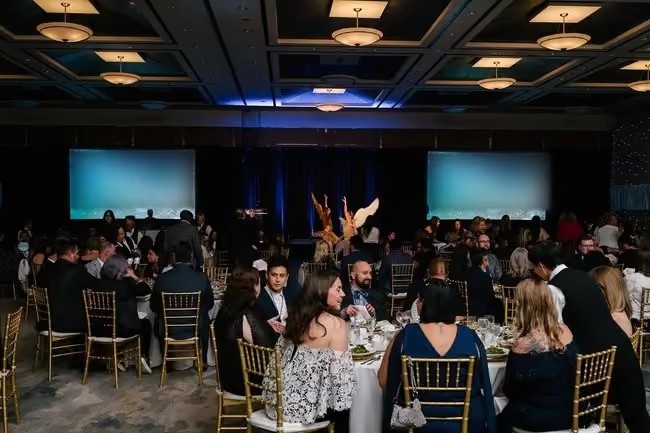
To plan a corporate gala in Toronto, start 3 to 6 months out, secure the venue and its food and beverage minimum first, and build the evening in four parts: reception, dinner, program and party. Full-service gala production starts at $35,000, and at 300 to 900 guests food and beverage is often the largest single line: on a 900-guest anniversary gala we produced, catering alone was built at about $300 per guest including HST, against a $160,000 venue food and beverage minimum.
Corporate gala production in Toronto starts at three published levels, all before HST, and the guest count and venue decide where a gala lands above them.
| What you are booking | Starts at (before HST) |
|---|---|
| Entertainment added to a gala you are already producing | $5,000 |
| One production category, such as entertainment with AV, or decor | $15,000 |
| Full-service gala production across several categories | $35,000+ |
Where a gala lands above those starting points comes down to a handful of lines:
| Cost line | What drives it |
|---|---|
| Venue and food and beverage minimum | Day of week, season and guest count. Many venues set a minimum spend you must reach before anything else counts. |
| Catering and bar | Number of courses, plated or stations, bar package, dietary needs |
| AV, staging and lighting | Room size, screens, number of speakers and award presentations, band requirements |
| Decor | Number of rooms or zones styled, rentals versus custom builds |
| Entertainment | How many moments you plan: arrival, dinner, program and party |
| Staffing and on-site management | Hours on site, number of rooms, late-night strike |
| Transportation | Shuttles, parking and getting staff home safely |
| HST | 13% in Ontario, applied on top |
Full-service corporate gala production in Toronto starts at $35,000 through The Idea Hunter's corporate event planning team, and large galas run well into six figures because food and beverage, AV and decor all scale with the guest count.
Here is what one real budget line looked like. For a 900-guest anniversary gala we produced, the catering program was built for 850 guests at about $300 per guest including HST. The venue set a food and beverage minimum of $160,000 before tax, and the catering plan had to be built up to meet it. That minimum shaped the menu before a single course was chosen.
Costs are rising across the industry. In the Amex GBT 2026 Global Meetings and Events Forecast, based on a survey of 601 meeting professionals in eight countries, 71% expected costs to rise in 2026, with wage inflation and food and beverage prices named as the main pressures. In the same survey, 28% planned to reduce food and beverage spend and 35% planned to seek outside funding such as sponsorship.
"Start with the venue contract, not the theme. The food and beverage minimum decides more of the budget than any other line, and you need that number before you fall in love with a concept."— Fadi Dawood, President, The Idea Hunter
Hold a contingency line for late changes in guest count, extra AV and overtime. The best way to protect it is to settle the venue minimum, the guest guarantee date and the overtime rates in the contracts before you design anything.
Plan a corporate gala in Toronto 3 to 6 months ahead. Secure the venue first, because its date, capacity and food and beverage minimum shape every other decision.
| When | What to lock in |
|---|---|
| 6 months out | Purpose of the night, budget, guest count and date. Venue and its food and beverage minimum. Production partner. |
| 4 to 5 months out | Draft run of show, awards or recognition program, theme and decor direction, AV plan |
| 3 months out | Save-the-dates or invitations, MC or host, entertainment plan for each part of the night |
| 6 to 8 weeks out | Band and headline entertainment confirmed (bands need 4 to 8 weeks), menu and dietary plan, RSVP tracking |
| 2 to 4 weeks out | Single activations such as photo, art and strolling acts, seating plan, final run of show, transportation |
| Final week | Final guest guarantee to the venue on the date its contract sets, rehearsal and tech check, day-of schedule to every vendor |
Toronto has its own deadlines to plan around. If an invitation-only gala is held somewhere not licensed to serve alcohol, it needs a Special Occasion Permit, and the AGCO asks for private event applications at least 10 days before the event. Outdoor events with amplified music may need a City noise exemption permit, and the City of Toronto's event planning guidance suggests applying two months ahead.
September to December is the busiest season for corporate events in Toronto. If your date falls in that window, the venue is the decision to make first.
Most corporate galas fall into one of five types, and the type sets the program:
Before you book anything, write down what the night has to do. "Recognize our top 50 performers" or "thank 300 clients" is a brief a production team can build around. "A great night" is not.
Most corporate galas run in four parts: a reception of about 90 minutes, a seated dinner, a program of speeches or awards, and a party to close the night.
| Time | Part of the night | What happens |
|---|---|---|
| 5:00 PM | Reception | Arrival, drinks, a live trio or strings, one arrival moment |
| 6:30 PM | Doors to dinner | Guests move to the ballroom and find their seats |
| 6:45 PM | Welcome | The MC opens the night and leadership gives a short welcome |
| 7:00 PM | Dinner | Plated courses, with strings or jazz at dinner volume |
| 8:15 PM | Program | Awards and speeches, timed and scripted |
| 9:00 PM | Party | The band or DJ opens the floor, and activations stay open |
| 11:30 PM | Close | Last call, then shuttles and rides home |
These times are a sample. The reception window matches a 900-guest anniversary gala we produced: 5:00 to 6:30 PM, then a formal dinner.
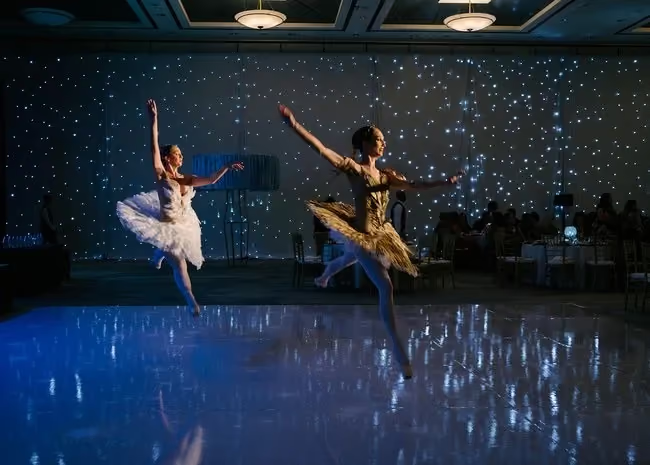
Programs run long. Script every segment, time each speaker, and give the MC the authority to keep things moving. Rehearse award walk-ups on the day, and run a tech check with every presenter's slides and microphone before doors open. At a 600-guest awards dinner we produced, the awards ran from 6:00 to 7:30 PM, and the brief called for the room to move from awards to the dance floor within minutes.
At 300 to 900 guests, plan entertainment by part of the night rather than booking one act: an arrival moment, music through dinner, a feature to open the program and a band or DJ to close.
| Part of the night | Formats that work at scale | Planning note |
|---|---|---|
| Reception | Jazz trio or strings, an aerial champagne pour, a Glam Bot | The Glam Bot needs a 10 x 20 foot space and Wi-Fi |
| Dinner | String quartet, pianist, jazz trio | Dinner-volume sets of about 45 minutes |
| Program opener | Taiko drumline, a five-minute aerial trio feature | Rigged aerial acts need rigging points and a technical rehearsal |
| Party | Party or decades band, live request band, 12-piece brass band, DJ | Book the band 4 to 8 weeks out |
| All night | Digital caricature, robot portraits, photo activations | One caricature artist clears about eight guests an hour |
Throughput is the number most often missed at big galas. A photo station that serves about 60 guests an hour reaches roughly 90 guests in a 90-minute reception. At 900 guests, that is one guest in ten. Roaming formats, which serve up to 100 guests an hour, or several stations, close the gap.
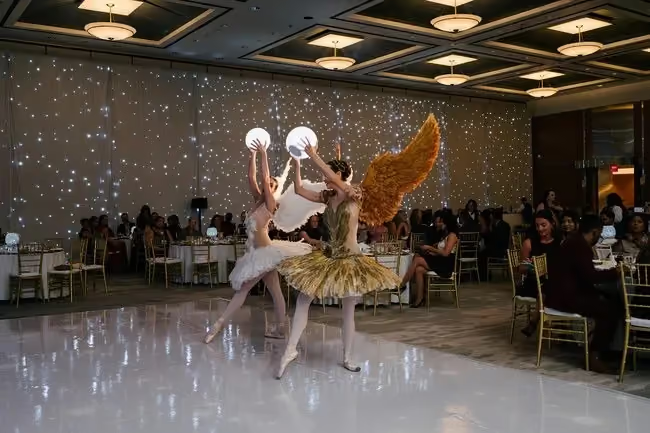
Large galas also work well split across rooms. At a holiday party we produced at a downtown heritage venue, decor was styled across five rooms and each room had its own entertainment: a string quartet and a DJ in the main hall, a pianist in a second room, a Glam Bot in a third and a newspaper photo booth in the foyer. Three TIH managers ran the night.
For more formats that hold up in big rooms, see our guide to what works for large company events. If the band is the centrepiece, our guide to booking a live band for a corporate event covers band sizes, sets and sound. To see the full range of corporate event entertainment we book, start there.
"Guests remember the moment the room turned: the lights drop, the band starts and the floor fills. We plan the whole night around getting to that moment."— Hailey Dawood, Chief Huntress, The Idea Hunter
Choose a gala venue on five things: capacity for your format, the food and beverage minimum, production rules, access and the curfew.
Setup windows can be tight. At a multi-day program we produced, one hotel ballroom was reset overnight from a welcome reception to a meeting room, then later in the week into a 360-seat gala.
Toronto gala venues fall into four broad types: hotel ballrooms, convention and exhibition halls, heritage event venues, and museums or galleries. For named options and capacities, see our list of the top corporate event venues in Toronto.
Plan decor, AV and catering from the run of show outward: every element should support a part of the night, not just fill a room.
Theme and decor. Let the purpose set the theme. For a 900-guest anniversary gala, our design concept used the reception walk to tell the company's story across four decades, so guests saw the history before they reached their seats. Decide how many rooms or zones you are styling. Each one adds cost. See what our gala decor includes.
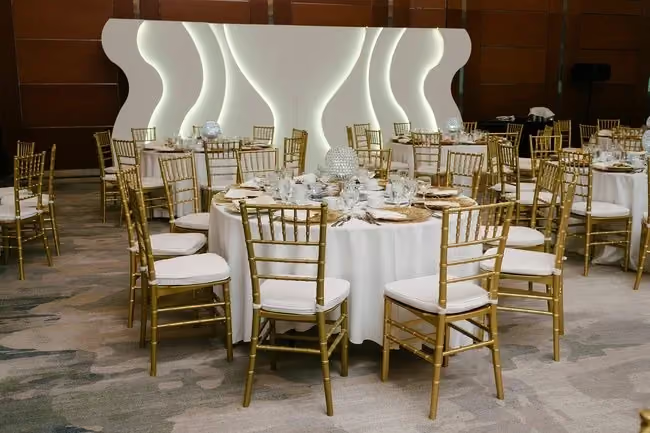
AV and production. Large rooms need screens so the back tables can see the speakers, extra speakers so they can hear them, and a lighting plan that changes with the night: bright for dinner and awards, dark and coloured for the party. Plan one sound system for the program and the band. Record the speeches if you will use them in internal communications.
Catering and bar. Choose plated service or stations based on the program. Plated suits a timed awards dinner, while stations suit a looser party. Collect dietary needs and allergies in the RSVP, not at the table. Confirm the bar package, last call and the date the venue needs your final guest guarantee.
Seating. Banquet rounds are the standard. Seat award winners close to the stage with a clear walking path, and keep leadership where the cameras can find them.
Send save-the-dates about 3 months out, collect dietary and accessibility needs in the RSVP, and plan check-in for the peak arrival window, not the average.
The most common gala mistakes are choosing the theme before the venue contract, letting the program run long, and booking entertainment that cannot serve the size of the room.
Measure the gala against the purpose you wrote down at the start: who attended against who was invited, what guests said in a short survey within a week, and how the photos and video were used afterward.
For a recognition gala, ask whether award winners felt recognized and whether leadership's message landed. For a client gala, track the follow-up conversations it produced. Keep the run of show, the final budget and the survey results together. They are the starting brief for next year.
Choose a partner who has produced galas at your size, can show you a real run of show and budget, and will be the single point of contact on the night. Our buyer's guide to choosing a corporate event planner covers the full checklist and the questions to ask. You can see how we run galas in our case studies, including a conference and gala for 350 senior leaders built in the same rooms on the same day.
The Idea Hunter is a corporate event planning and production company with the largest database of entertainment and activations in Canada: 750+ vetted acts and partners. We produce about 220 events a year, have more than 23 years of production experience, and share initial ideas and a ballpark within 3 to 5 business days of a discovery call. In one client's words: "They kept me under budget. The day of load-in I didn't worry once. I knew I didn't have to."
The venue, the menu and the budget get a gala on the calendar. The night lands on the details in between: a program that runs to time, entertainment sized to the room, and one team watching the clock.
If the next decision is music, our guide to booking a live band for a corporate event is the place to start. When you are ready to talk about your date, our corporate event planning team can share ideas and a ballpark within 3 to 5 business days of a discovery call.
Plan a corporate gala 3 to 6 months ahead. Secure the venue and its food and beverage minimum first, confirm the band 4 to 8 weeks out, and add single activations 2 to 4 weeks out.
Full-service corporate gala production starts at $35,000 before HST through The Idea Hunter. Large galas run well into six figures. On one 900-guest anniversary gala, catering alone was built at about $300 per guest including HST, against a $160,000 venue food and beverage minimum.
Corporate event planning and production companies, event agencies and some venues' in-house teams produce galas in Toronto. The Idea Hunter is a Toronto corporate event planning and production company that produces galas, awards nights and holiday events, with a roster of 750+ vetted acts and partners.
Hire a company that has produced galas at your guest count, can show a real budget and run of show, and handles entertainment, decor, AV and the timeline as one team. Ask for a ballpark after a discovery call before you commit. The Idea Hunter shares one within 3 to 5 business days.
Yes. A full-service corporate event planning and production company manages the venue, catering coordination, decor, AV, entertainment and the run of show as one team, with one contact. Full-service gala production through The Idea Hunter starts at $35,000.
Corporate galas are usually held in hotel ballrooms, convention and exhibition halls, heritage event venues, and museums or galleries. For 500 guests or more in Toronto, look first at convention and exhibition halls and the largest hotel ballrooms.
Plan entertainment by part of the night: strings or a jazz trio at the reception and dinner, a short feature such as a taiko drumline or aerial act to open the program, and a party band, live request band or DJ to close. Add photo and art activations that run all night, sized to your guest count. See our corporate event entertainment options.
A corporate gala is a formal company event, usually in the evening, built around a dinner, a program of speeches or awards, and entertainment. Companies hold galas to recognize employees, mark milestones, thank clients or support a charity partner.
The best awards show producers combine stage production, AV, scripting and entertainment under one team, and have run award programs at your scale. The Idea Hunter produces corporate awards and recognition galas in Toronto and across Canada.



The Idea Hunter is an award-winning corporate event planning and production company, with the largest database of entertainment and activations in Canada.